The biggest political event in early June 1991 was the first-ever election in Soviet history of a Russian President, with Boris Yeltsin winning the backing of over 45 million voters, equivalent to over 57% of the Russian electorate. His running mate and now Vice President was a former military officer Alexander Rutskoi who had been awarded the title of Hero of the Soviet Union after his role in the Soviet-Afghan war, which had lasted a decade, ending in 1989.
Yeltsin’s growing role in politics over the past few years was now bolstered by actual popular support, thereby undermining the position of Mikhail Gorbachev as Secretary General of the Communist Party and Head of State of the Soviet Union, given that Moscow was the centre of power in the USSR. It was clear that this situation could not last, in particular, in view of the enmity between the two men and the tensions this was creating in the politburo. Admittedly Gorbachev would get a short-lived respite thanks to the US-USSR summit scheduled for late July.
Meanwhile, I was delighted to finally obtain an exit visa to go home for a week, heading back with British Airways on a flight paid by my dad that I naturally reimbursed once I had accessed my bank account back home and recovered some cash in the midst of an abortive attempt to salvage my relationship. Nevertheless, it was a positive break. I spent some good time with friends, including Simon from Europa and Paul from Novosti in London, and also saw my mate Phil from university who was making good progress in his career in sales.
I was also offered some proofreading work from the managing editor of Europa Publications who proudly told me that they would soon be switching to electric typewriters. I was a bit ahead of them in that sense. I spent one night over at a friend’s place, only to come home and see that my mum was distressed. Both my parents were still recovering from my late brother’s passing, which had also hit my other brother Adrian hard and led to actions on his part that were naturally a concern in particular for them. As Helen was in Japan and I was in the USSR, we were of course upset to hear this, but had been less affected due to the distance.
However, I was now seeing the repercussions close up. My father had suffered atrial fibrillation the night of my absence. He hadn’t been sleeping well and had always had high blood pressure. He took me aside and asked me to promise to watch over mum if anything were to happen to him. Naturally, I agreed and did my best in subsequent years to keep that promise. Luckily he seemed better before I left.
I returned to Moscow, flush with cash and recharged. I was also fairly busy at Novosti as most of the Russian translators were either on holiday at their dachas in the summer or working as interpreters and earning in the process a considerable amount. Their English was phenomenal. At Novosti we all worked on Olivetti desktop personal computers, primarily the Olivetti PCS 286, which had an Intel processor and operated on MS-DOS 3.3 It also required the use of a 3.5-inch floppy disk. In the morning we would receive a page cut out from one of the newspapers for translation from one of the clerical assistants, usually Vera or Svetlana. Subsequently, they would download the translation onto a floppy disk and take it way for printing. Or Jennifer, Steve and I would receive a printed text for editing, plus the original Russian. Similarly, if we had freelance work from a client, they would provide us with a disk for downloading the translation.
I had one strange client that year from North Korea, who requested that I edit a book of recollections of Kim Jong Li, the late leader of the Democratic People’s Republic of Korea, on Juche, the country’s official ideology. They agreed to pay cash dollars, so naturally I accepted the work from two emaciated North Koreans in shabby green suits that didn’t fit. They said they were 25, but looked over 50. When I handed over the edited version, I saw the two of them again, plus a third individual sporting a black leather jacket and black sunglasses who looked far healthier and younger. After receiving payment and a bottle of vodka containing a worm, I commented that he looked like a member of the secret police, leading to weak denials. Not surprisingly, I didn’t receive a repeat commission.
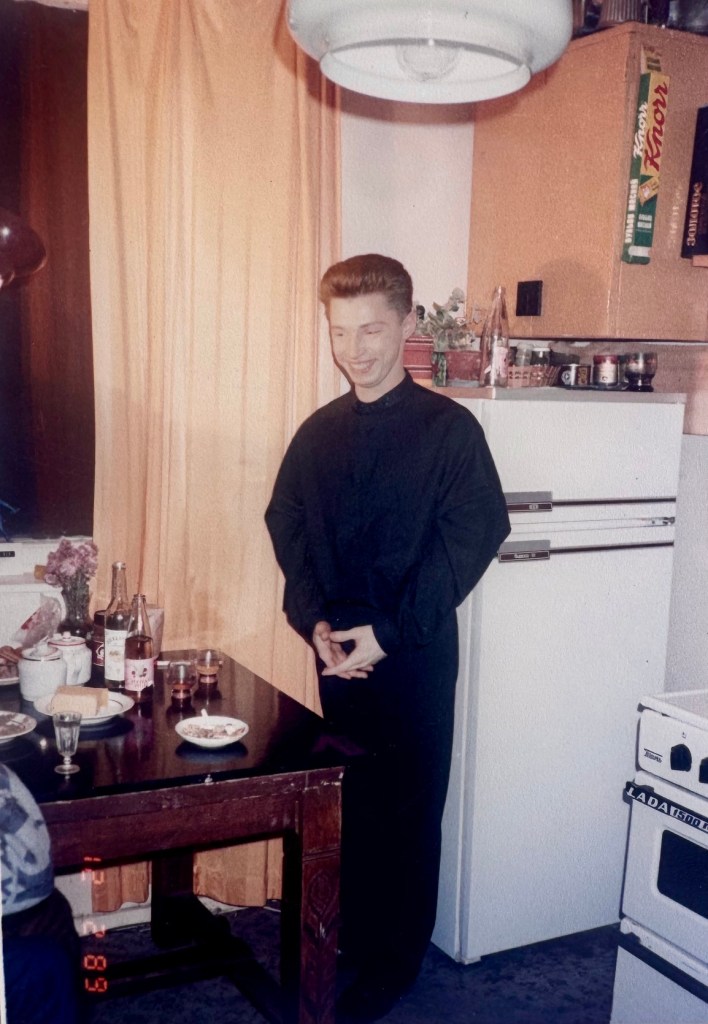
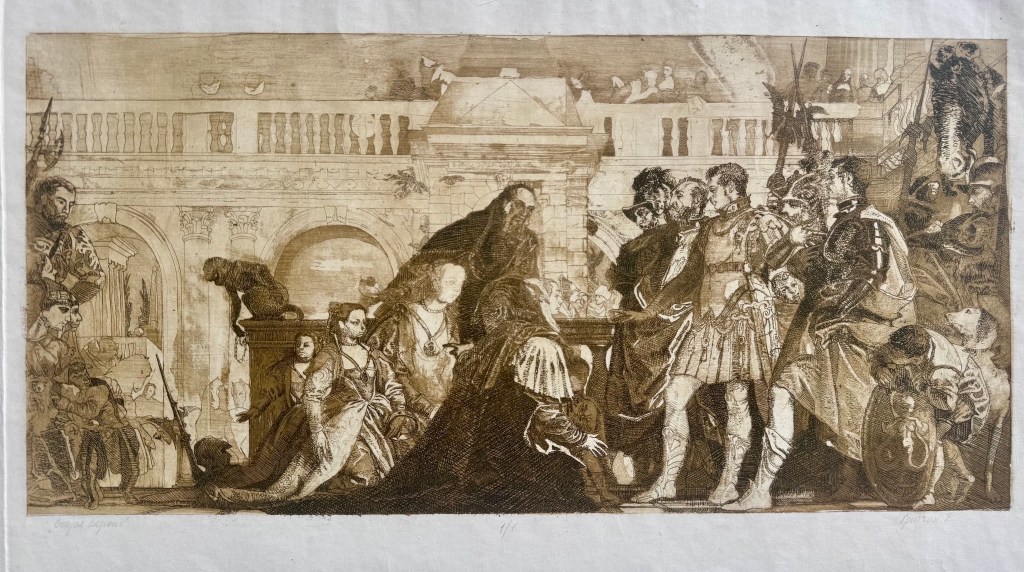
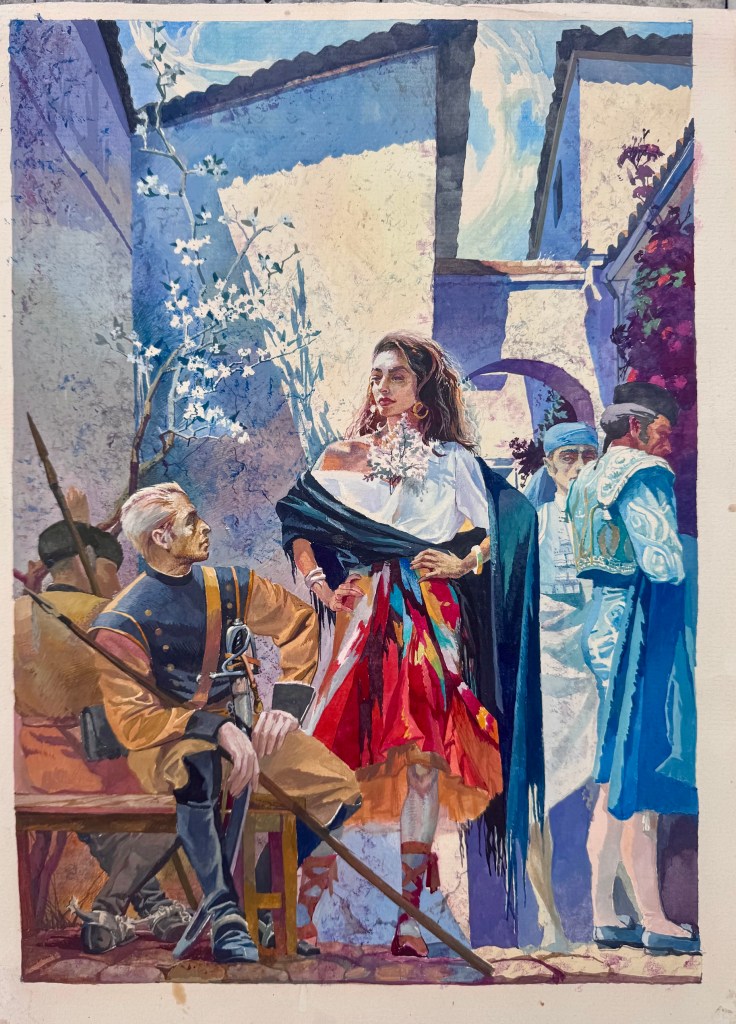
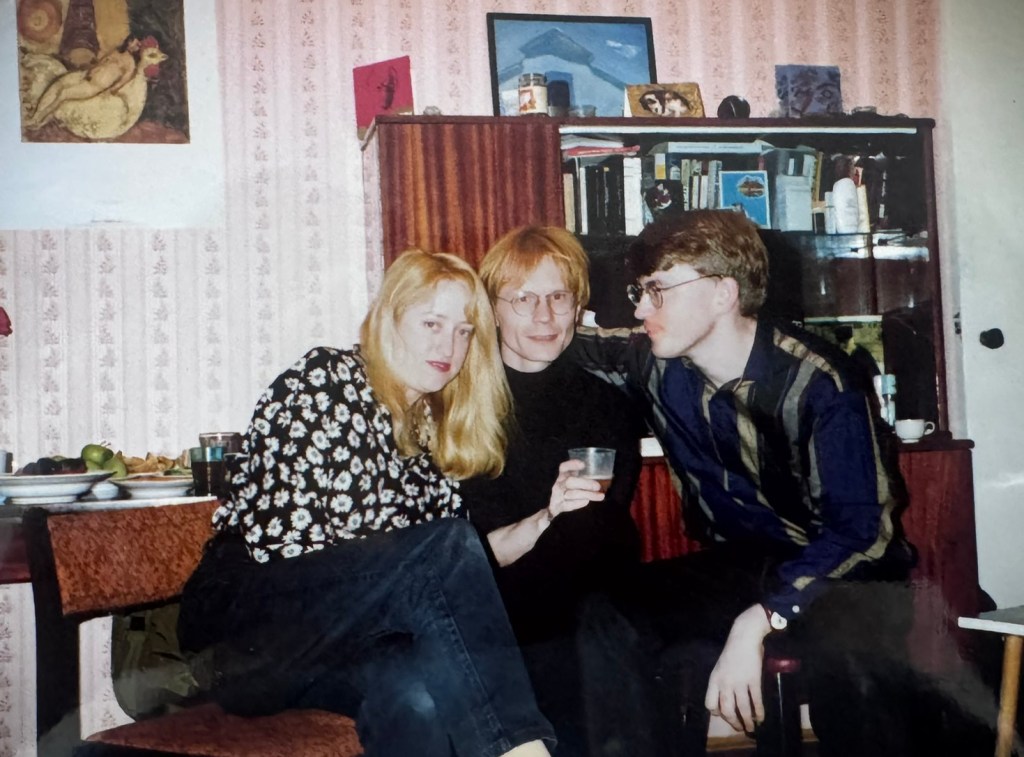
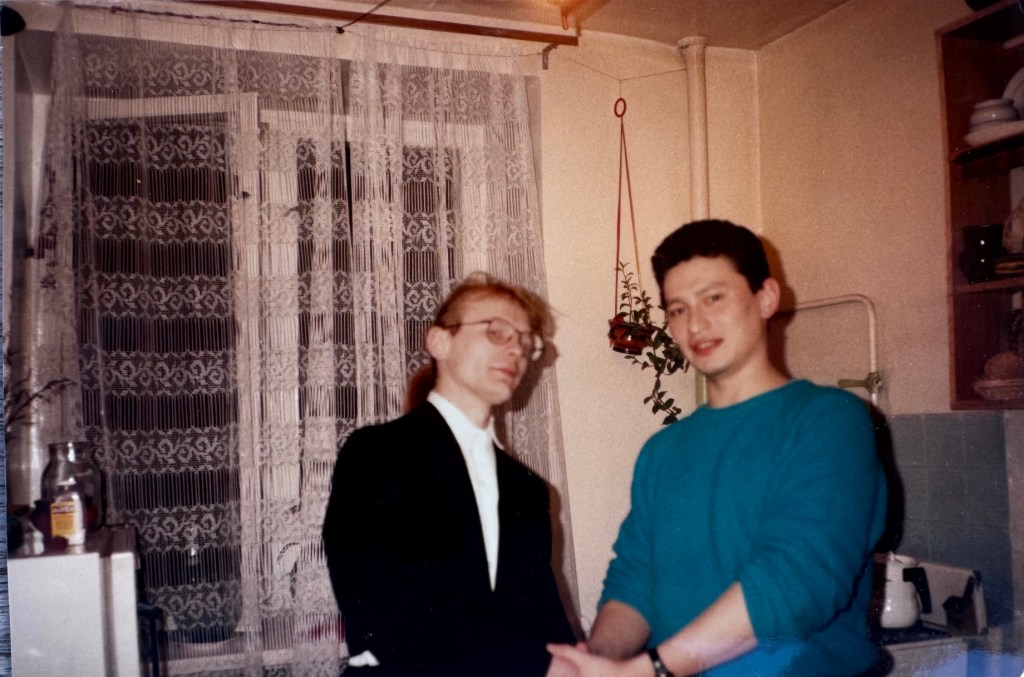
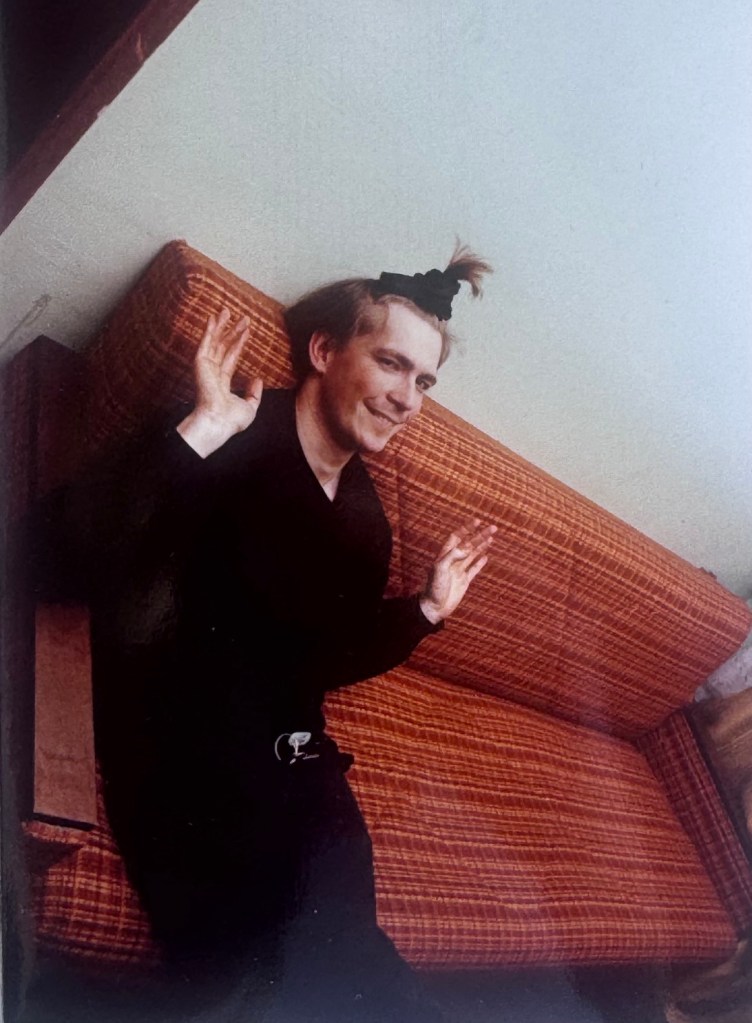
As I was busy, I would now hold occasional parties at my top floor flat with small balcony, attracting up to 30 people, from Tim and Moira, Jennifer, Steve and David to Suzanne, Pavel, a number of artists, some actors and actresses. Naturally it was cramped, but loud and fun. As well as the Kazakh artist Manas Kisamedinov, I was to have the good fortune to get to know an outstanding painter, draftsman and book illustrator, who had a phenomenal knowledge of both ancient and modern art, boasted a rich vocabulary and stood out due to his elegant dress attire. His name was Genya Gritchin and I was to see him regularly, learning a great deal more than he would ever derive from me. I am glad to say that I have re-established contact. He has been successful throughout his career and now lives in Genoa, Italy. I attach here a link to his website: https://www.genyagritchin.com. I also provide below some more photos of his works from back then and the people I have mentioned from those days, kindly provided by Suzanne. I feel very lucky to have managed to reconnect with such established artists as Suzanne and Genya. It is good to see that they achieved the success that they more than merited.
And then George and Mikhail met in Moscow. And I was unfortunately far in the background. But that is another story.
Genya Gritchin in his Moscow flat
Early work by Genya Gritchkin
Another early work by Genya Gritchkin
Pavel, Suzanna and yours truly
Pavel and Manas
Yours truly


Leave a Reply