In early May 1991 Jennifer came up to Steve and me in the corridor at APN and asked us whether we would like to accompany her to Georgia. Accommodation would be free, as would most of the food. All that we needed to do was buy a cheap rouble ticket on the national carrier Aeroflot – no exit visa was required from the authorities, as this was a trip to a republic of the Soviet Union. Accordingly, there would be no passport control. The trip would last four days and coincided with the May Day holidays. Steve and I were sold on the idea from the outset, curious to see another republic and understand the appeal that the final destination had held both for Stalin and subsequent Soviet leaders, as well as anyone who had the necessary connections to go there.
Jennifer’s friend lived in the coastal town of Sukhumi in Abkhazia, an autonomous republic within the Georgian Soviet Socialist Republic. An ethnic Abkhaz, Abga (meaning wolf) was a policeman there, as was his brother Davit whom we would meet later that day. Skirmishes between the Abkhaz minority and Georgian majority between 1989-1991 had been reported in the press. They both stated categorically at the time that there was no antipathy between Abkhaz and Georgians. Clearly, once again the events had been orchestrated by an external third party. A lot of the blame for conflicts in the Soviet Union and subsequently can be laid at the door of the divide and run policy implemented by the politburo under Stalin.
Leaving Sheremetyevo Airport in Moscow on a chilly Friday morning where winter was loathe to take its leave, sleet all around and the temperature hovering around 5-7 degrees Celsius, the plane was to land almost four hours later in warmer climes in Sochi (plus 15), home to the North Caucasus summer beach resort town bearing the same name. And then it was a drive at maximum speed in two hours to Sukhumi – normally the journey would take almost three hours.
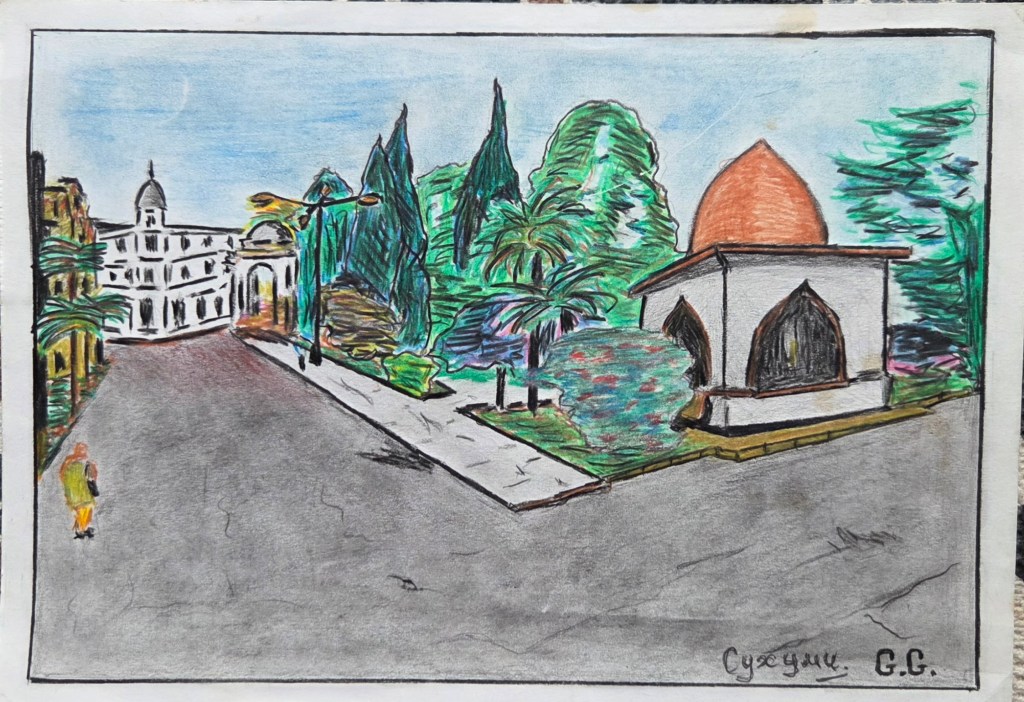
Sukhumi was at the time a beautiful compact and well-kept city off the eastern coast of the Black Sea, boasting a history dating all the way back to the 6th century BC, settled first by the Ancient Greeks and then the Romans. Previously known as Tskhumi when part of the Kingdom of Akzhazia established in the 780s and then as part of the Kingdom of Georgia in 1008, the city had also been occupied in different eras by the Ottoman Empire and the Russian Empire, before being subsumed as an autonomous republic within the Georgian Soviet Socialist Republic. That is, before the fateful war from 1992-93, engineered by “big brother” under Boris Yeltsin, with similar events happening previously in Nagorno-Karabakh (Azerbaijan and Armenia) and subsequently in Moldova, Chechnya (twice), Georgia again in 2008 and then in Ukraine from 2014 until now (late 2026).
As well as the idyllic setting, situated as we were in a brick house close to the sea, the variety of the food was a total shock to the system, from the local khadchapuri (cheese bread), to the nut-based dishes, copious amounts of fruit, especially mandarins and grapes, spicy vegetables and meat and excellent Turkish-style coffee, and one more item I had sorely missed in Moscow: wine.
I was soon to discover that Georgia is rightly known as its birthplace. For it transpired that wine-making dated back 8,000 years there! Among the techniques deployed in the country, as well as home-made wine concocted without sugar, Georgia is home to the tradition of making wines in clay pots known as Qvevri which are placed underground as part of the fermentation process. As of today (2026) there are over 500 known grape varieties in the country.
On that first evening in Sukhumi the policeman Abga invited us to attend an outdoor wedding reception, attended by at least 1,000 people, both Georgian and Abkhaz. Admittedly we arrived late to the main event. However, there was still food in abundance, wine and the Georgian version of vodka, chacha (grape vodka), 40% alcohol-proof. A toast-maker (Tamada) would make a number of toasts. After each toast, you would be expected to down a shot and then sniff brown bread, allegedly in a bid to reduce the impact of the chacha running through your body. If the gap between them was deemed excessive, our neighbours at the table would readily propose additional toasts. As most people were already inebriated after several hours of such toasts, I managed to fake it on a number of occasions, drinking water instead, but still felt the worse for wear when we left late in the night towards 3:00 or 4:00 AM. At some point Abga stopped the car abruptly, He told us to get out. He took out his pistol and fired towards the surrounding forest into the night. He then said it was our turn. However, this was not an offer, but an order. So we duly took our turns to fire, hoping against hope that we did not injure anyone in the process.
All nursing a hangover, it came as a relief that Saturday was more leisured and offered a welcome break from alcohol. We were driven to a packed sandy beach in Pitsunda in Gagra District, the favourite haunt of former Soviet leader Nikita Khrushchev, who was incidentally deposed from power while holidaying there in October 1964. Gagra was so popular in the Soviet era that it merited a mention in an amusing call from a phone booth in a scene in the 1973 comedy Ivan Vasilievich Changes His Profession directed by Leonid Gaidar. The sea in Pitsunda was warm and a beautiful green, while the atmosphere veered from fairly raucous and boisterous to comparative silence as the beach slowly emptied.
Sunday was similarly fairly calm at first, that is, before we were offered a chance to sightsee in Sochi. And the moment when the two brothers decided to pursue at breakneck speed in their Lada two Russian girls in a taxi all the way to Sochi, with the three of us crammed in the back. When we raised objections to the chase, we were dumped on the road side unceremoniously.
We decided there and then against a day-trip to Sochi, returning instead to Sukhumi. After walking for a while, we caught a bus back to the city, all struck by the original ornamental designs of various animals in vivid bright colours at the bus stops. After enjoying a leisurely afternoon by the beach, eating fruits and drinking coffee, we completed our stay that evening at a local café, wolfing down both egg and meat khadchapuri and enjoying some excellent Saperavi red wine surreptitiously brought to the table in the evening.
The next morning we agreed to return to Sochi Airport without relying on Abga’s aid, catching instead a taxi and admiring the beautiful greenery and scenery. The fresh air throughout the trip was indicative of the lack of pollution in the region. And then we endured the long flight back in an overpacked plane and return to the Moscow cold where an increase in the political tension was palpable.
Before I move on, I feel obliged to mention a young courageous Russian journalist Dmitry Kholodov who reported from Abkhazia on the ethnic cleansing of Georgians in Sukhumi in 1993 during the first Russian-Georgian war, conducted with the clear approval of Boris Yeltsin’s regime. He was to uncover more murky dealings in the Russian army only to be murdered in 1994. As was the case of many journalists over the years, the Russian police and secret services failed to find the culprit, which was not surprising as they were clearly protecting their own work sanctioned by the Russian regime. An article in Wikipedia mentions Kholodov’s superlative journalism https://en.wikipedia.org/wiki/Dmitry_Kholodov.
Painting of pre-war Sukhumi by Georgian artist G. Gurtskaia
If you want to see all of the previous 40 or so entries, just subscribe!
And if you have any comments you would like to share, please feel


Leave a Reply