So Voronezh it was. A relatively small town in the South-West of Russia, with a population of approximately 850,000 in 1984, located 535 kilometres from Moscow. To get there, we were loaded onto a rickety overnight train. As it was still September, I couldn’t fathom why everyone was wearing boots. Late at night in almost pitch darkness I had to go to the toilet. It was then that I understood: there was a blockage, apparently a regular occurrence on the night train, leading to overflow. Hence the need for boots to stay dry. I evidently failed in that mission. And naturally there was no toilet paper, one of the phenomena I had read about, but had obstinately refused to believe. However much one might have mocked British Rail back in the day, on my return to the UK I was grateful for the cleanliness and care for customers in comparison. As the train approached the city, virtually all of us were overcome by a sense of apprehension.
And yet it was bright and sunny that morning, lifting the mood.. We were deposited by bus at Hostel No. 2. It would probably be more appropriate to call it a dorm or student accommodation. We were divided into groups of two and taken up to the 4thfloor, if memory serves me right. Two of us would be distributed at random to a room with four beds. The other beds were occupied allegedly by Soviet students, but most likely KGB operatives or both. They would monitor our movements in the days and months to come. I appeared that one of the two in the room I inhabited was a high-ranking party member, as a procession of changing young females would pass the night regularly with him. However, at least we now had the perfect opportunity to practice our Russian which was admittedly rudimentary at that point.
As well as the Soviet guards checking our every move, we were to become familiar with similarly unpleasant termites in the kitchen, corridor and worst of all in our rooms – at times the beady-eyed cockroaches seemed omnipresent, scuttling around freely, most ominously during the night.
The toilet was another unpleasant feature – the flush hardly ever worked. So after doing your business, you would put the “informative” material that had served as your toilet roll in a wastepaper basket. It goes with saying that the pungent smell and unavoidable sight of the product within hastened the time spent on that seat.
And this is the moment when we realised why the daily newspapers Izvestiya (News) and Pravda (Truth, albeit not really) would sell out fairly quickly. They would be cut up by the locals into squares and assume their main function as toilet paper.
I remember one day in early December when the supermarket Detsky Mir (Children’s World), which sold all manner of goods, from chess sets and toys to school supplies, shoes and clothing, also unexpectedly had a delivery of Soviet toilet rolls. Naturally this long sought-after product triggered a long queue within a matter of seconds.
As a rule, such queuing was a feature of everyday life, as the Soviet central planning system led to inefficient distribution, overproduction and the simultaneous inadequate supply of the goods most in demand, with little consideration of the requirements of different population categories. For example, there were never enough shoes of the right size, while the quality tended to be shoddy. The population would wait until the arrival of better imports from the German Democratic Republic (East Germany). As this was the height of the Cold War, the majority of resources in the USSR, and in particular in Russia, would be channelled to heavy machine building and the manufacturing of various weapons, once again marked by overproduction, in particular of tanks.
So shopping in general was a protracted experience and bizarre to a Westerner. Initially you had to queue up in a store and indicate what you wanted to buy. The shop assistant would hand out a piece of paper where they had written down the name and price of the good, for example, potatoes. Then you would go and join a second queue to pay the cashier at a kiosk, have the chit stamped and then queue for the third time to hand over the chit for the potatoes. Of course, if you had the misfortune to forget anything, you would have to repeat the whole process. Even more strangely, I was to experience this bureaucratic nightmare a few years later at a bookshop where I was to spend considerable time in the centre of London. But that is another story.
At least, that was the initial reaction we all had when we landed (what a classic hit from Foreigner, though). Perceptions change over time though. Today it is very hard to imagine the size of the Soviet Union – over twenty-two million kilometres, with Russia accounting for seventeen million. According to a 1989 census of the USSR (there was no census in 1984), Russia accounted for more than half the total population – an estimated 147 million out of 286 million in the Soviet Union as a whole – and at this time the USSR had the third biggest population globally after China and India. While Kazakhstan was second biggest in terms of size, Ukraine claimed that ranking in terms of population, with over 51 million people.
Back in those days students would be sent from different English universities to a few cities in Russia or to Minsk in Belarus for three or 10 months, depending on their degrees. It would no doubt have been enjoyable to spend that time in Moscow or Saint Petersburg, or even the Belarusian capital, but I didn’t have the contacts. So it came to pass that I ended up in Voronezh for three months, plus a few days in Moscow and a week in St Petersburg.
We were sent there at the start of our third year in early September 1984. After four hours on a British Airways flight to Moscow, in the good old days when the airline was prestigious and you would be treated to a good lunch and copious alcohol with your ticket, we immediately sensed the stark difference in mood and surroundings on leaving the plane. The drink didn’t block that out.
The international terminal Sheremetyevo-2 was a dark and forbidding place. Its bleak look added to a sense of dread. Given the flight restrictions imposed on Soviet citizens (it was virtually impossible to travel abroad back then), the building was virtually empty. In addition, nobody smiled at us, from the porters to passport control and customs officers. It made you feel that you were not wanted and should at the very least have the courtesy of looking miserable.
After the luggage arrived, every single bag was opened and searched meticulously for potentially illegal anti-Soviet propaganda (in particular, such provocative material as bibles), or more probably in the hope of confiscating cigarettes or booze in excess of the set allowance. Then we were left to sort out the mess that had been made, picking up the items that had been chucked on the ground. On leaving the environs of the airport, we were shipped onto a sterile yellow and white LIAZ-677M bus and taken to a shoddy hotel in Moscow.
And the food wasn’t much better. Cheese, boiled eggs and hard brown bread, and some kind of meat. The Indian tea was good with sugar, while the coffee took a while to get used to.
We visited the usual tourist traps: Red Square, St Basil’s Cathedral and Lenin’s Mausoleum. Unfortunately, in case of the latter, a long perusal was prevented by the guards and pressing from people behind us.
The most frustrating aspect was the lack of interaction with the population. Everything was controlled and everyone we met in Moscow was clearly a KGB stooge at some level. Nats and I decided with a couple of others to try to eat in a restaurant at 1-2 PM. However, either it was closed for lunch or we managed to secure a table, but nobody would serve us even though we were surrounded by empty tables.
And then the following morning we were split into different groups: the lucky ones staying in Moscow or bound for Saint Petersburg, Minsk (Nats) and Voronezh (yours truly). The journey there was also memorable, but for all the wrong reasons.
Forgive the time gap, dear readers. I will keep this entry short as the second year at Queen Mary College, London University, passed by uneventfully, marked by French and transatlantic romances, plus the lead role in Russian in a theatre production.
It was also preceded by a highly enjoyable three months back at the camp site in Arcachon near Bordeaux. My positive mood at the time was reflected music-wise in the UK by such top eclectic hits in summer 1983 as Every Breath You Take, Red Red Wine, Wherever I Lay My Hat (That’s My Home), Flashdance… What a Feeling, Gold and China Girl, penned respectively by The Police, UB40, Paul Young, Irene Cara, Spandau Ballet and David Bowie.
And it was even better second time around, as I now was accorded greater responsibilities and could adapt the schedule to compete in table tennis tournaments, beating the French No. 5 that year, and make the most of the largest sand dune in Europe. As well as a higher salary and 12 weeks of an emotional rollercoaster, the summer was topped off by romance with a 25-year old biochemist Claudie at the site and a week with her in Paris. While there , I also managed to catch up with Isabelle and Etienne’s mother.
And then the return to studies, fun chats over coffee and beer with Nats, and pub crawls with best friends Phil and Russell, including long evenings at The Hog in the Pound on Bond Street. They were an essential component of the student experience that I always recall with a smile.
I did return to see Claudie for another week just before Christmas. However, we were clearly on a different wavelength – she proposed to me out of the blue. I was 19 and definitely wasn’t mature enough for a serious relationship back then. I was keen to continue the relationship and see how things might pan out later on as she meant a lot to me., However, my pleas evoking Tina Turner’s December hit “Let’s Stay Together” were all in vain.
Shortly afterwards in early 1984 I helped out my parents with issues related to my eldest brother John. A successful broker, he had a problem with alcohol, caused no doubt in part by his first wife who couldn’t wait to move him on. I still remember him regularly and fondly, especially the many months we spent together at the time and subsequently.
And then there was Toni, a lovely Italian-American girl with whom I would spend a wonderful spring and early summer. However, this was followed by three weeks in Youngstown, Ohio (instead of the planned two months), which were far less enjoyable. It was my turn to be rejected. Admittedly crashing her mother’s car may not have helped. However, Toni did turn up unexpectedly on my doorstep in our new house in Richmond in summer 1985 and then at my work place, leading to a couple of drinks, but I had moved on a month earlier. So in late July I returned to the UK and found work through a temp agency at a Coca-Cola bottling plant, drinking far too much Fanta and Lilt, a beverage that was sadly scrapped in 2023. George Michael’s Careless Whisper, Nik Kershaw’s Wouldn’t It Be Good and Prince’s When Doves Cry summed up my feelings at the time.
Going back to March that year, I had been given the role of Don Juan for some reason in Pushkin’s Stone Guest . At one moment in the blank verse drama he kisses a blonde widow. She was played by a stunning fellow Russian-English student Joanna, albeit one year ahead. That particular scene was photographed many times by Toni…
And then summer came to an end. It was time for something completely different.
To be continued…
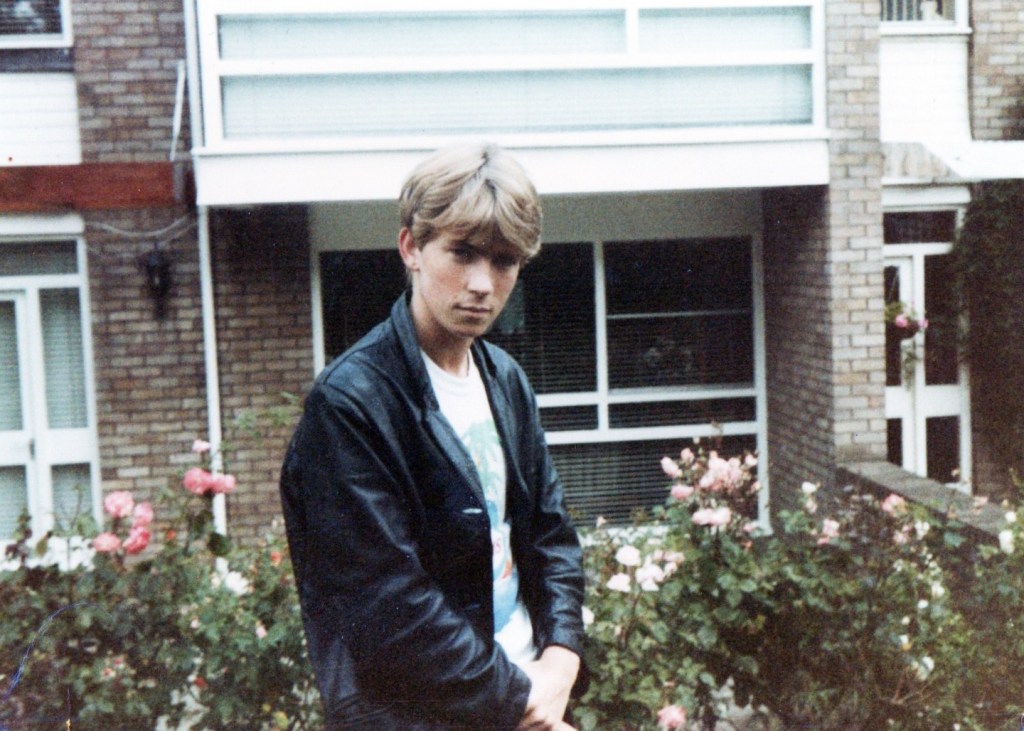
Taken after the return from Arcachon. I loved that leather jacket.
The early 1980s were another prolific period in music, from Roxy Music to David Bowie, Kate Bush, The Police, The Clash, The Jam, to Madness, The Specials, Adam Ant, Ultravox, Duran Duran and The Pet Shop Boys. Obviously there was much more, but that will have to do for now. Politically, it was a time of student protest against Thatcherism.
Whereas school is a rite of passage you have to endure, university was a choice, that is, if you were lucky enough to make the cut back then. It is worth recalling that back in those days only 7-10% of school leavers attended the 38 universities available in the 1980s, predominantly men. Most students had access to grants that covered their university lodgings and other costs, but could also get low-cost loans where necessary, while university fees were only introduced in September 1998. We were a fortunate generation compared to the financial hardships and loan debt built up by students in the 2000s and beyond.
I opted for Queen Mary College, London University, known since 2013 as Queen Mary University of London after an earlier merger with Westfield College. I lived at home in part as my grant was not sufficient to rent a room and I was not eligible for lodgings. However, it was mainly due to domestic issues where I was required to help my mum and dad.
Back then (we are talking here September 1982) it took a good hour and a half to get there by tube from Ealing Broadway after walking 15 minutes from home to the station. As I got on at the beginning of the line, however, I was always guaranteed a seat and could use the time to catch up on any late reading of literature or language for my combined honours degree in French and Russian.
I had picked the Slavic language as it was something different – my sister had studied Japanese, while at the time I didn’t realise that my Dad had acquired good knowledge of Russian from his earlier studies and World War II. None of that had been disclosed back then. I refused to believe all the reports about the Soviet economy and food shortages, control on foreign visitors, etc. The course offered both a year teaching English in France or studying French at a university there and three months in a city in the USSR, which was allegedly selected arbitrarily. So five years in total, a longer period of freedom before entering the workforce full time for good.
I made a few good friends in the first year, doing French – Phil and Russell – and Russian – a stunning blonde Natalie (Nats). I got back in touch briefly with Phil who built an excellent career in sales before retiring. I also had the good fortune to reconnect with Russell. Curiously they both ended up in Northern Ireland.
Russell has had an eventful life, including a spell in Australia where he met the love of his life, and has been successful ever since, helping other people both as a counsellor (you can find superb videos that he has made as Russell Edwards on LinkedIn, YouTube and TikTok) and as one of the best languages and special needs teachers. He is like a long-lost lost brother to me and is a constant support. He has an extraordinary memory and is working on his autobiography, as well as a novel. They deserve to be picked up by a publisher and developed into a series on Netflix, Amazon Prime or another outlet.
Back then Phil, Russell and I did all the usual things, hanging out at the discounted university pub, coffee bars, going to clubs and getting pissed at drinking dens of iniquity like the Hog and Pound on Bond Street. Meanwhile Nats and I tended to hang out during the day.
These were the best times of our lives thanks to the breath of freedom of the day, a lack of stress or concern about the future and a fascinating and turbulent period in both domestic and international politics, arts and music, all the more so, as apartheid and the Cold War would soon come to an end. Not before my three months in the south of Russia though…
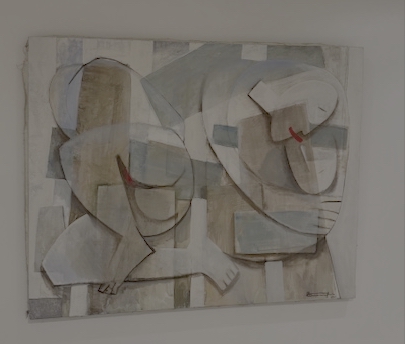
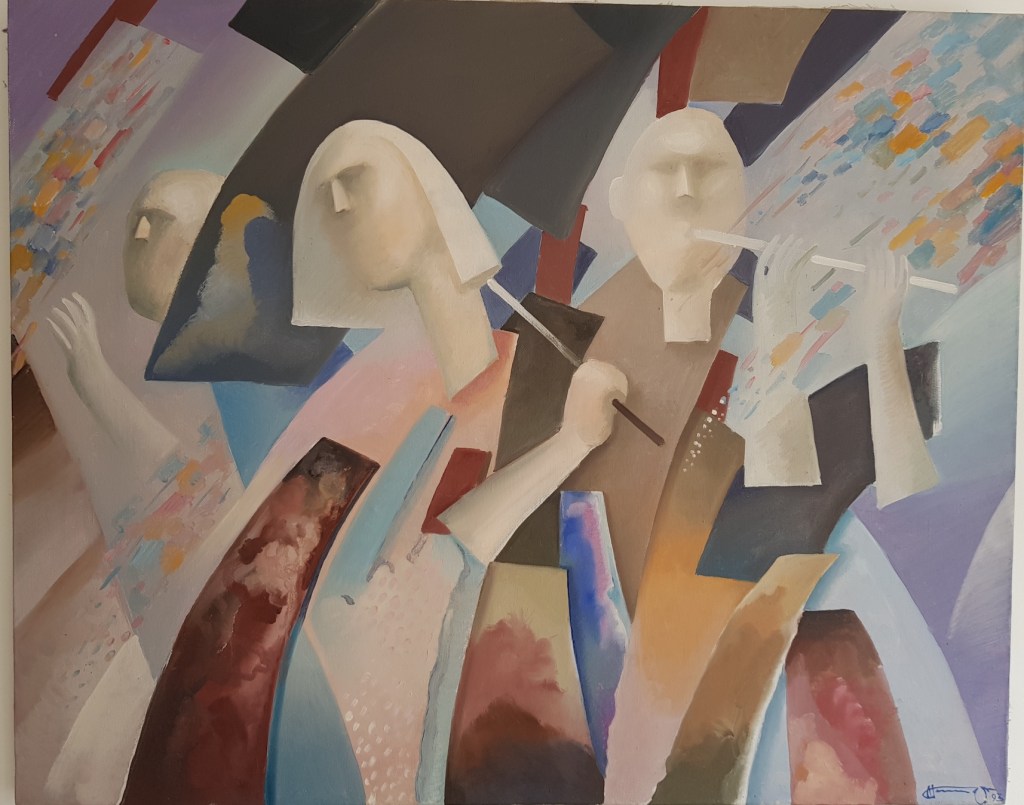
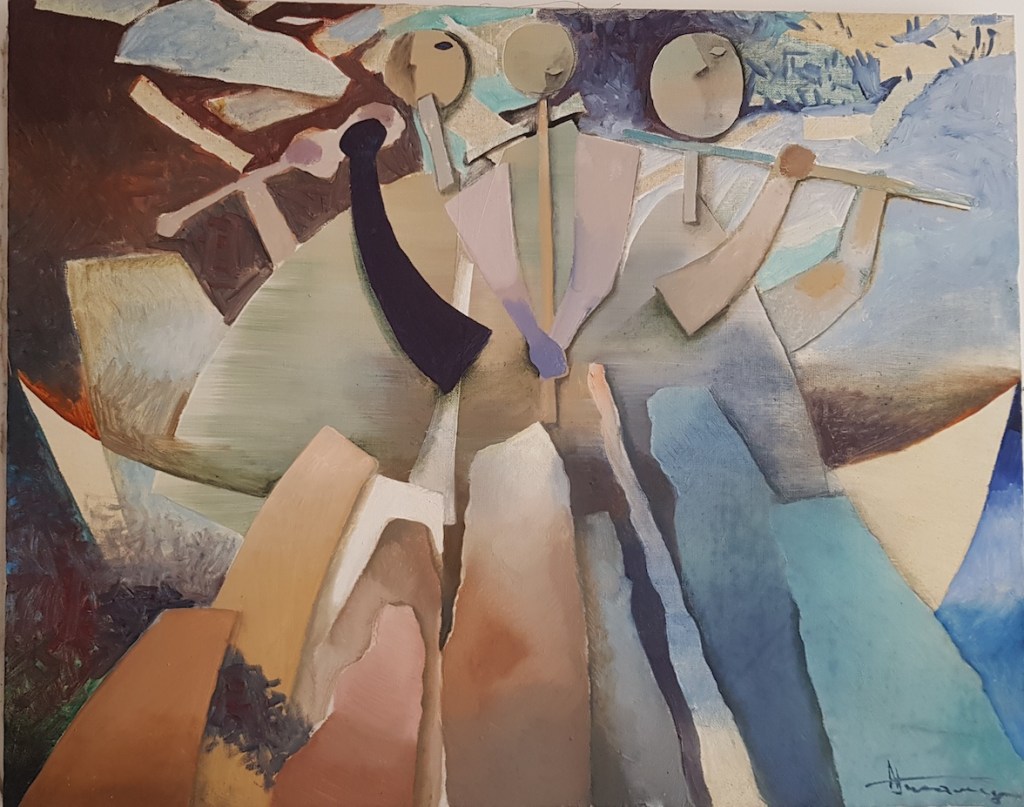
Painting by Manas Kisamedinov, Kazakh artist (1995)
Apologies once again for ruining the chronology of this tale. I have been remiss in omitting some events that had a positive impact. The first one brings to mind a Scottish friend who stayed with us in Hampstead – Angus MacDonald, who hailed from a prosperous family. In exchange I was invited to stay with his family and go horse riding, which was good until my nag decided to canter and then gallop. Luckily I managed to cling on. Clearly I was not made out to be a jockey.
In addition, I was afforded at the age of 15 the opportunity to work for the first time at his father’s company for a few days for the princely amount of 60 pounds, which seemed a lot back then. It was around Christmas and on the last day, 24 December, I was invited to a party where I imbibed a lot of alcohol, sleeping it off on the train. Not content with this excess, in the evening I went with school friends to a local pub where they kindly bought me five pints, in particular, a particularly strong version. Apart from the excessive alcohol in the system, the only problem was a promise I had made to my sister to go to Midnight Mass with her. A promise I naturally didn’t keep.
Another story post A levels also springs to mind. In summer 1981 Etienne’s mother asked my parents if her now fifteen-year old son could stay at our place for a week to improve his English. I was told to talk him solely in English. I promised to do my best. However, Etienne played dumb and feigned ignorance. So we conversed in French. Then I introduced him to my friends Chris and John. Unfortunately, they too ended up having to try to speak French. However, one afternoon we were walking towards Ealing Broadway and saw 30 girls on Ealing Green. The perfect opportunity.
We decided to approach them and suggested that they go to the cinema with us. It transpired that half of them were French. It was a bit surreal for the two of us going to the cashier accompanied by 30 girls. I ended up sitting next to Catherine. The film was Chariots of Fire. However, I don’t recall any of the movie. Catherine and I stayed in touch as friends for many years to come. Etienne’s English didn’t improve and I apologised to his mother in person with some choice pastries from a Parisian boulangerie a few years later.
In January 1982 I had a lot of time on my hands before potential admission to university in September. So while waiting for responses from other universities, I worked for the temp agency Manpower in a variety of short-term menial positions, primarily washing pots and pans at Heathrow Airport, but only until June.
I had applied the previous year to a camp site in the south of France where we had gone camping for a week as a family instead of Italy. I received in March an offer of a three-month contract and the opportunity to make some cash. Camping de La Dune in Arcachon, Bordeaux, was located right in front of Europe’s tallest sand dune, still over 106 metres above sea level in 2018. It was breathtaking and a different world. In addition, I worked in the evenings as an usher at an outdoor cinema. By the end of my time there I felt more self-confident, driven by the fact that I had been forced to get out of my comfort zone – from introvert to extrovert. I highly recommend anyone suffering from shyness to take the plunge – you have nothing to lose!
It looked at the time as if France would dominate my future. I loved and still love the language, culture and general laid-back attitude to life. I also have to this day two good French friends and a number of French people among my acquaintances. However, as time will tell, appearances can be deceptive.
Once again apologies for readers and subscribers. Here I continue on what is a key issue for my profession. I also mention again the offer for investors in Kazakhstan and art fans.
The risks posed by AI today for professional translators, agencies and clients mirror similar issues raised by previous disruptive technologies: machine translation and translation memory software. I will consider here the evolution of the industry in one country, the challenges that it created and the opportunities going forward for everyone ready to forsake short-term profit for a sustainable, long-term business.
Back in the early 2000s in Russia translation software providers, such as Trados, for example, sought to persuade companies to acquire their software by offering free training to the translators that they employed. Naturally, the sale was predicated on two differing strategies depending on the audience.
The providers promised the companies more consistency, greater accuracy, and a subsequent reduction in translation costs, as it would be possible, as it was euphemistically put, to “optimise” the number of translators employed, supplemented where necessary by assistants. Thanks to the in-house translation memory, subsequent bilingual deliverables would take less time and require less experienced staff.
At the same time, the providers sought to convince translators that the software would free them from having repetitive translations, standardise their translations, and improve consistency, thereby enabling them to take more time on their work thanks to the software aid.
In reality, texts still differed significantly, but the translators found that they were expected to translate far more than in the past, as it was assumed by management that the translation memory made their work easier.
However, if you are able to translate rapidly, (on the order of 5,000 – 10,000 words a day), the use of translation software inevitably slows you down due to the need to laboriously enter the text into the program. Later on, the software providers targeted translation agencies, citing consistency, but above all efficiency savings at the translator’s expense. I myself opted not to choose the software option and would then be required by agencies that operated such systems to agree to lower pay for repetitive text (down to zero) and a reduction of the actual paid word count by over 50% in the case of so-called “fuzzy” text, even where there were material differences between instances of “repeat text”, which required careful consideration. Shortly afterwards I stopped working for them.
It struck me that there was no tangible long-term benefit for the translator. A number of the agencies spearheading the use of such software closed down, as the final product was far from perfect, due in part no doubt to the quality of the work of the translators who were persuaded to agree to extremely low rates.
And then along came machine translation, soon superseded by the allegedly superior AI versions. The translator is reduced to the role of a glorified editor of machines spurting out gibberish which in a number of cases has to be “corrected”, in other words re-translated by a translator paid for editing, which is generally half the rate for translation.However, the problems of relying on software have been building up in industry over the past two decades. I will provide here a couple of real-life examples of where it can all go wrong. A couple of colleagues used at one point Trados software as demanded by an advisory firm, both while employed in-house and subsequently as freelancers. Initially, they would be asked to translate audit reports on listed companies from Russian into English using the software. After a couple of years, the reports were no longer assigned to the translators, as they were handled in-house by the respective industry departments, primarily by non-native speakers, in particular audit assistants newly hired employees whose English was far from perfect and who were usually under significant time pressure. On a couple of occasions, I was contacted by a concerned audit partner who requested a translation review of the current version of audit reports on two clients in Russian and English.
I did a painstaking check that took in each case as long as if I had translated the texts myself from scratch. In both instances the two allegedly identical Russian and English versions differed by 20 to 30 per cent. Here the issue was resolved positively, as a conscientious partner had had the good sense to contact a professional translator.
However, if such checks aren’t requested, a number of risks can arise. In the case of an audit and advisory firm, this concerns firstly reputation risk and fees. The client expects professional work, notably that deliverables will be accurate and consistent, and chooses a provider that is respected by industry competitors, shareholders and potential investors and stock markets. Any shoddy work is likely to lead the client to look elsewhere, notify others of the experience, including the media, and also demand a refund. Concerns about translation quality may trigger worries about the underlying audit work.
However, the problem doesn’t stop there. Let us assume that a client is seeking investors or plans to raise capital. Conflicting versions of financial statements and audit reports will not inspire confidence. Even worse, an investor or lender might at some stage sue the client on the grounds that it was misled by information that differed from one version to another. The client in turn might well take the audit firm to court.
Such reputational and litigation risks are directly attributable to the use of translation software where the required oversight is missing. And translation error can prove costly.
In 2014 I was appointed as an expert in a dispute involving claims of more than USD 100 million. I was asked as the expert translation witness to provide an expert opinion (expert review) on the meaning of certain terms where three different Russian words had been translated as value, even though the common translations were price, value and amount. Some form of software had clearly been used to ensure this consistency! These errors were of particular concern when the text concerned the share price on a particular date rather than the nominal value of the shares. As a result of the expert review, the court proceedings were cancelled at the last minute.. I had effectively saved the client USD 100 million.
So it can actually pay in the long run to turn to professional translators rather than relying on software or machine translation. Other risks related to use of the latter are also now emerging. As in AI, machines must be trained on an initial corpus, which is obtained from an unknown source by a law firm or agency. There is no clarity as to the actual source, and downloading a company’s data or translator’s data in the initial data used by the machine is potentially unlawful. Litigation could also arise due to the use of language which is indicative of set phrases or branding terminology used by specific companies.
However, the key issue today is one of liability. Translators take out limited liability insurance, which as a rule covers them for translation, and not editing. So what happens if there are errors after a post-machine translation edit? And how is the liability assigned if a number of translators were used in a legal contract/case or valuation assignment (a vendor due diligence, for example)? The deadlines for such work are often tight, and different texts are distributed between a pool of translators.
If the translator cannot be held liable, then does this mean that the agency is to blame? Or what if the errors were due to the initial data used to train the machine? Or is the law firm to blame, if some amendments were stylistic changes made by a lawyer who didn’t like the way something had been translated or edited? And when were the errors initially made in court cases which can go on for years?
Clearly, there is a problem in the use of any type of translation software if the professional translator is accorded a nominal role, paid a minimum amount, and expected to work rapidly on assignments where it is virtually impossible to obtain the necessary insurance and where in actual fact the agencies should be responsible for such cover.
Notwithstanding the risks, there is an opportunity: audit, advisory and law firms and professional agencies will eventually be required to draw on the expertise of professional translators to translate the initial texts and the revised versions and pay them equitably. This should not be a problem, all the more so as in a number of jurisdictions such work is tax-deductible. There is clearly also a need for companies to request translation reviews by professional translators of previous texts, unless they want to scrimp today while potentially facing litigation tomorrow.
Other opportunities will follow. Let me provide one more example. There are areas where AI and machine translation cannot help: intuitive understanding of the underlying risks in proposals and deliverables. Seminars and conferences on the potential of professional translators to enhance the quality of texts, promptly identify and notify clients of potential pitfalls in the original text, including excessive assurance included in the deliverable that could trigger lawsuits from their counterparties, and proposals on how to avoid such risks, would boost the relationship between industry professionals and their clientele. Better networking between translators in different languages for the delivery of multiple language services to public sectors, where perception and concern over the impact of the text on the final recipient and non-disclosure are prioritised, for example, the National Health Service in the UK for medical reports.
I have been lucky to have good agencies and have built up a good relationship with them. They know that they can count on me to deliver a professional translation every time and to adhere to non-disclosure undertakings, to point out where there are errors and assist where necessary round the clock.
Here I turn to potential investors or art lovers. I sponsored an artist from Kazakhstan for many years in the 1990s. His name was Manas Kisamedinov. He became a close friend. Unfortunately he passed away at the pinnacle of his career from a drug overdose, dying far too early, as did his late a father, the famous graphic artist Makum Kisamedinov. In return I would receive works of art. I show here and in the next article paintings that appeared in previous blog entries. More paintings and graphic works will appear in later entries. As time passes, I am now ready to pass them on for the right price naturally.
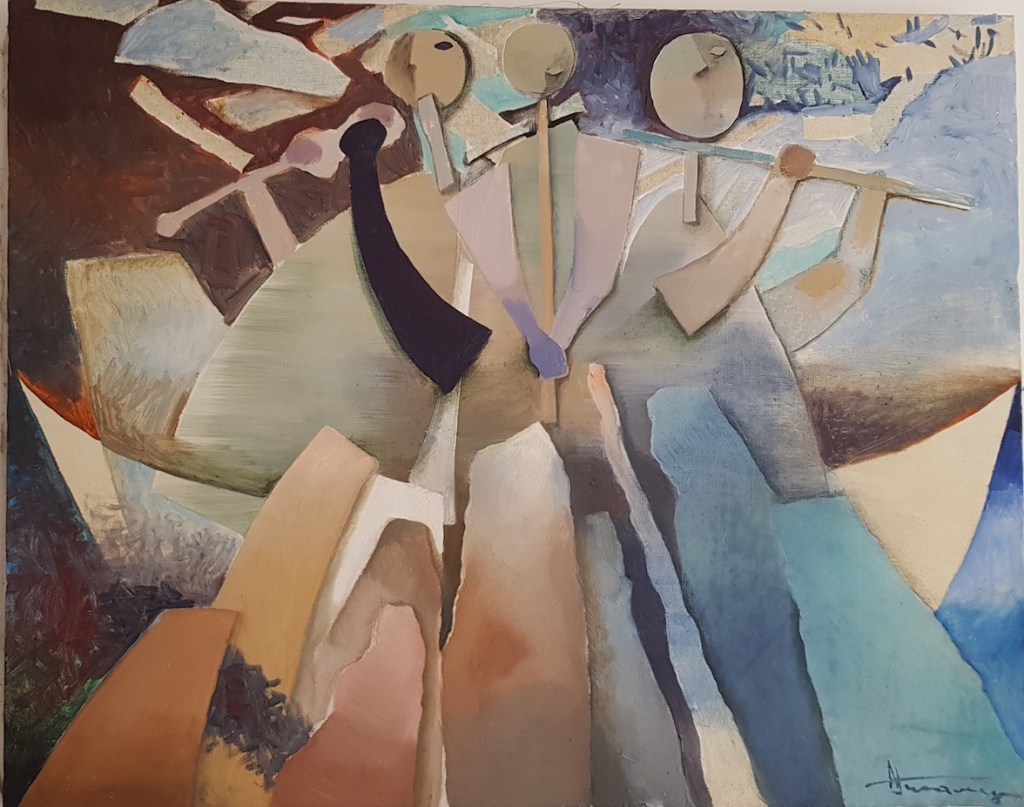
Painting by Kazakh artist Manas Kisamedinov, 1992.
Drawing on the Monty Python title, I am taking a break here and in the next blog entry from the autobiography for two reasons. I want to warn readers and subscribers that the next couple of blog entries will deviate significantly, based on my personal experience as a translator. I also have an offer for investors seeking to curry favour in Kazakhstan or to contribute to the country’s cultural heritage, or indeed art lovers keen to brighten their estates with abstract art. In this blog entry I will summarise a couple of issues. In the next entry I will draw on an article (as yet not submitted for publication) where I expand on the topics below.
I wanted to draw attention to the risks posed by translation software and more recently by machine translation and its sidekick AI. The adverse impact of AI applies to many sectors, not only translation.
A short introduction. For the past 15 years I have been offering a 24-hour translation and editing service to one law firm in Russia together with a friend and fellow translator from Canada. We also offer services to other clients. We understand the fundamental importance of delivering a quality product on time. We also know how communications between the client and provider can improve the deliverable and generate a circle of trust, something that tends to be lost when translations are entrusted to agencies. A discussion of any concerns about a text or request for an updated version as soon as possible proceeds much more swifty if there are no intermediaries. Moreover, discretion is key to the success of such interaction. We sign non-disclosure agreements and adhere to them.
Recently we have been contacted by law firms and agencies over their concerns about the litigation risks arising from overdependence on AI translations and even AI edits. In response, we have developed an AI translation litigation risk review service where we analyse texts and highlight errors in the AI translations that could result in millions of dollars in losses in case of litigation. The service addresses concerns arising over the varying and haphazard nature of AI translations and the potential damages that may arise if errors in texts are not spotted on time, or indeed on the possibly recovery of losses attributable to the use of faulty AI translations by a contracting party. We also address copyright issues and the breach of non-disclosure undertakings arising from the use of AI systems.
We also know how over time the quality of a specific deliverable may deteriorate for reasons that are often beyond the control of the auditor or client. For example, there have been instances where we were asked to review the quality of the translation of financial statements of a client and the accompanying notes after a few years when the translation had been updated in-house using translation software. The client was concerned owing to apparent deviations between the Russian and English versions. This might have been due to the involvement of different employees on the assignment. In the instances that we reviewed, the two texts deviated by over 20%. Naturally, such error engenders reputation and litigation risks for the company being audited and the auditor.
Indeed, translation error can prove costly. In 2014 I was engaged as a translation expert prior to a court case in the UK where one party was demanding USD 100 million in connection with differences over the value of shares in a company. The issue revolved around the terminology that had been used. Thanks to the expert witness report that I submitted, the trial was cancelled a week before it was scheduled to begin, saving the client the aforementioned amount.
We can help to prevent the onset of such issues with our professional quality translation service. Here we will compare the Russian and English versions of a report over the past one to three years (this could be an annual report, financial statements, tax or legal due diligence, valuation report, corporate governance and sustainability reviews, etc.), issuing a deliverable that covers the following areas:
Whether the two versions are actually identical in form and substance;
Whether the terminology is consistent throughout;
Whether the translation is correct;
What the impact of missing text might be.
Naturally, as and where necessary we also propose amendments to the translation (if this concerns the English translation).
We also offer a similar professional quality review of previous deliverables where the text is only available in English (for example, a report on an industry or enterprise prepared for a lender such as the EBRD, checking that there are no material errors of concern).
Here I turn to potential investors or art lovers. I sponsored an artist from Kazakhstan for many years in the 1990s. His name was Manas Kisamedinov. He became a close friend. Unfortunately he passed away at the pinnacle of his career from a drug overdose, dying far too early, as did his late a father, the famous graphic artist Makum Kisamedinov. In return I would receive works of art that have been displayed in my home for the past couple of decades. I show here and in the next article paintings that appeared in previous blog entries. More paintings and graphic works will appear in later entries. As time passes, I am now ready to pass them on for the right price naturally.
Painting by Kazakh artist Manas Kisamedinov, 1992.
The number one single Start by the Jam in early September 1980 seemed fairly apt. In the end I decided I didn’t want to go down that route and repeat the year, preferring to finish my time at school as soon as possible with my friends. Naturally, there was one down side to this decision – I had to focus on studying hard for once.
In the end this wasn’t hard to do, as apart from table football and the surreal experience of a sixth form where you had 15 girls and 150 boys with suppressed libido issues, the year was pretty uneventful, with one minor romance and more heartbreak not worth considering here. At the same time, it was more enjoyable owing to the knowledge that this period of my life would all be over soon.
At least some torments would come to an end, from the endless juvenile shouting of “boom boom” – in recollection of my first name and the children’s TV show with the toy fox Basil Brush, to “Basil!” – referencing the hapless hotel owner Basil Fawlty expertly played by John Cleese in the comedy series Fawlty Towers.
My long hair would also be the source of amusement for some, leading to comparisons to Lady Di, the one member of the royal family I have always respected, as well as to George Michael. In later life, unfortunately, the comparison would be less flattering – Elton John.
When I did poorly in the mock German A level exam (three pupils – two A students and yours truly close to failing) in May 1981, the teacher urged my parents to make me drop the subject. I was stubborn, refused and in the end got the grade required for admission to university. At the time I had planned to follow in my father’s footsteps and took entrance exams to go to Peterhouse College, Cambridge. However, I either failed the exams or interview (or both!) – admittedly, I was still a pretty immature seventeen-year old.
The one thing I do recall, both on finishing classes, then exams and subsequently entrance admission to Cambridge, was the sense of emptiness and loss, a realisation that I would probably never see again a number of people I had spent years getting to know.
It was a sense of isolation and solitude, no doubt attributable in part to uncertainty about the future. We receive no preparation for such a change in our lives and the negative impact can be telling. I know of a suicide that happened shortly after one fellow student completed his studies and wonder if this sentiment of detachment and void might have played a role. It would be good if the authorities or someone in society respected by the youth of today were to look into this issue and offer some solutions.
Apart from the friendships I made at school, a couple of whom I see to this day, albeit irregularly, I would be hard pressed to claim that I had enjoyed the experience. It is no doubt a rite of passage that can both leave lifelong scars and open up doors to new opportunities.
By contrast, I remember every day at university in London with pleasure and cherish the long-term friendships made back then both in the UK and during the time teaching and working in the south of France during the year abroad. I felt very lucky to embark on that journey where learning went hand in hand with something akin to burgeoning maturity.
Although I would soon turn 16, I still found the journey to France daunting – travelling solo for the first time by plane and then getting lost on the train as, laden down with bags, I attempted to make my way by metro and train to the south Parisian suburb Athis-Mons where I would stay.
I was very lucky to be housed at the weekends with a lovely divorcee teacher from the school which happened to be located close to her property. She had three kids, including Etienne, two years younger, who was to become a good friend. We bonded on music, films and football. One treat was the Sunday afternoon when her ex would come to visit, bringing tasty profiteroles and other pastries from some posh boulangerie.
Meanwhile the actual school seemed massive to me, coming as I did from an upper school consisting of 200 pupils. There must have been almost 2,000 students, all boys, ranging in age from seven to nineteen. And everybody appeared to smoke. So I started as well, albeit only a few cigarettes a day.
Naturally, I found it hard to adapt to French lessons, writing in French and penning philosophy papers when my vocabulary was pretty sparse, but I got there in the end. Translating from Ancient Greek and German into French also took a while to get used to. My maths and understanding of chemistry and biology also improved.
However, there was another challenge that I hadn’t expected. I ended up sharing a room with a French guy Michel (the name has been changed) who would constantly mock me. That was not the worst of it though. One evening every week a friend of his from Guadeloupe would pop in late at night and they would take it in turns to beat me.
I kept quiet owing to the threats they made if I were to dare say anything. As you can imagine, the frequent unprovoked attacks overshadowed the whole experience. Totally demoralised after three months , I let Etienne know. After he told his mum, I was transferred to another room with a really friendly kid Xavier. It taught me a lifelong that speaking out about a transgression, however humiliating it might feel at the time, can have a positive outcome.
This is when I actually started to have fun and appreciating the same tracks that would be blasted out every morning to wake everyone up before breakfast: the greatest hits by 10CC: Rubber Bullets, Arts for Arts Sake, I’m Mandy Fly Me, I’m Not in Love and the band’s number one hit from September 1978 Dreadlock Holiday.
I also wrote the lyrics to a number of songs at the request of a young sports teacher for his band. He was most complimentary about one song I wrote called Geranium Blues about a drug addict.
I took the end-of-years exams and passed them and was offered the chance to move up to the next class and take the baccalaureate. I must admit that I was tempted, but had other plans.
The year ended with a moment of true karma. Michel had a horrific motorbike accident. Luckily he recovered. He sought me out and apologised profusely for what he had done. The accident had led him to reevaluate the past. It was that rare instance of seeing how trauma can have a positive impact on an individual and has left an indelible impression on me to this day.
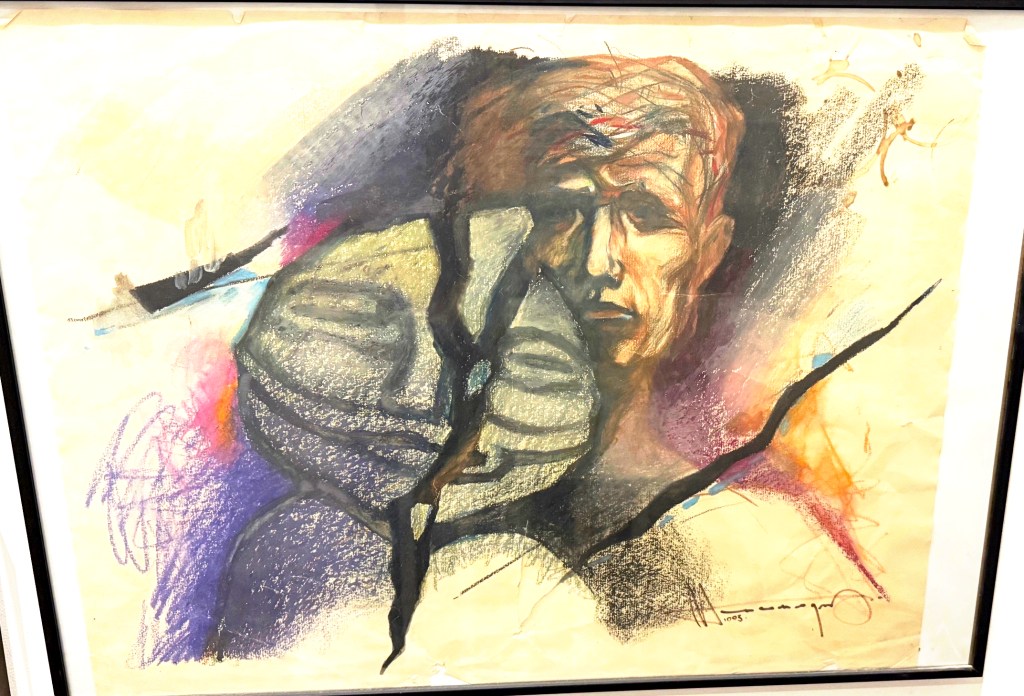
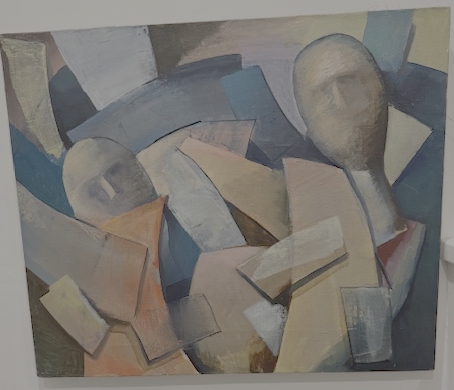
Another painting by the Kazakh artist Manas Kisamedinov.
The year 1979 is always connected in my mind to the only time I had a serious political disagreement with my parents – they had decided to vote for the Conservative Party led by Margaret Thatcher for the first time in their lives. They believed that she truly wanted to change the country for the better following the sanctimonious words she uttered outside Downside Street. They were to regret it as she caused havoc throughout, froze my dad’s salary and started a decade where she decimated society, and conducted a foreign war solely to ensure electoral success, a cheap and amoral political trick that is unfortunately so common these days. Another crime was the handover of council houses to tenants with no strings attached.
Don’t get me wrong. I realise that this move opened the door to home ownership to a significant number of people in all parts of the country who would never have been able to buy or change their lives so radically without this move. On that level it was a positive step and simultaneously a master stroke, enabling the tory party to control the economic narrative for decades to come.
However, the reform had one major drawback: the indicative short-termism of the policy with no attempt whatsoever to contemplate the housing crisis we see now more than 50 years later. Now there were far fewer council properties for those unable to buy a property or rent on the private market. Moreover, there was no onus whatsoever on construction companies to allocate a proportion of brand new builds as council housing. The tory party didn’t make any such demand and didn’t stipulate preferential treatment for UK residents going forward. As a result, there is a shortage of cheap accommodation available today, property prices have soared and nationalism has reared its ugly head, with Brexit one direct consequence.
Anyway, I felt very lucky to be a year younger than everybody else when I started my A levels at the age of 15 in the autumn term running until late December 1979, with Pink Floyd’s Another Brick in the Wall (Part II), aptly describing the angst kids felt around that time.
Study-wise, as well as Ancient Greek which I loved and French, I had opted for German, having completed an O level in business German and obtained a B. At the time I had agreed with my parents to drop back a year on completion of six months of studies in the “Second A” stream at the school in Paris.
Under the French Baccalaureate, students are streamlined early, in line with their abilities and/or in accordance with underlying academic drivers. The A stream is focused more on literature, philosophy and foreign languages, B on social sciences, languages and mathematics, and C on science and mathematics. As maths was never my strong point, it had to be A.
I was looking forward to a new beginning. However, the first few months of 1980 turned out to be far more harrowing than I had expected. But that is another story.
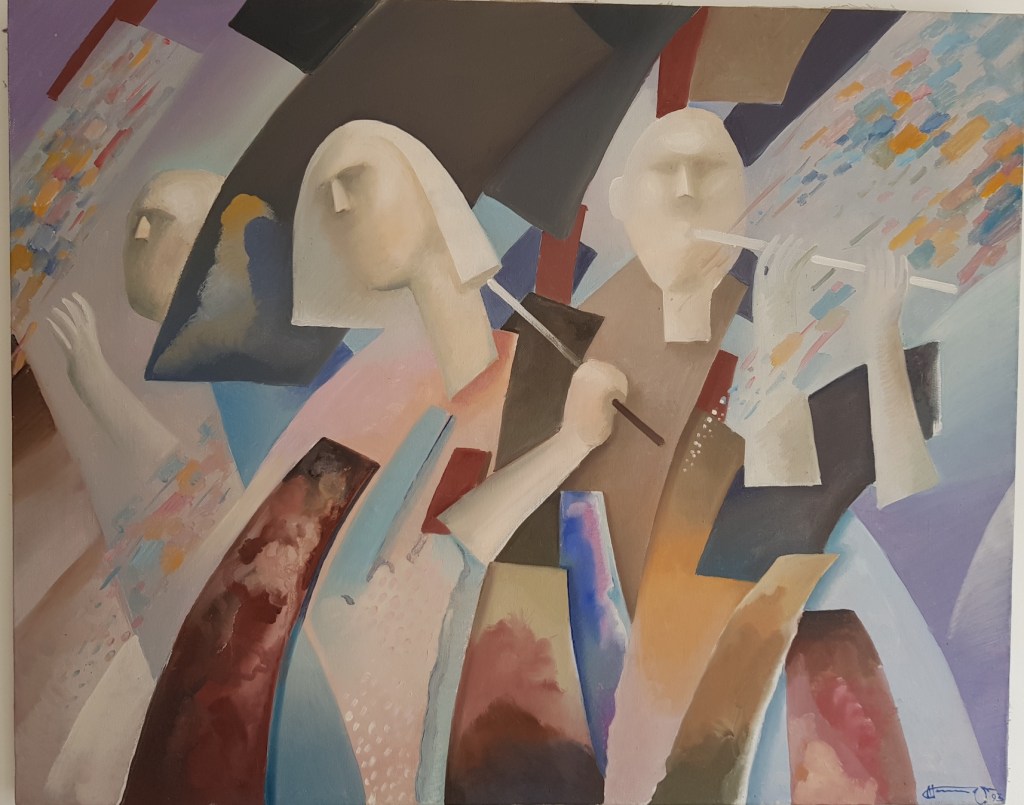
Painting by Kazakh artist Manas Kisamedinov (1992)
 Autobiographical
Leave a comment