Drawing on the Monty Python title, I am taking a break here and in the next blog entry from the autobiography for two reasons. I want to warn readers and subscribers that the next couple of blog entries will deviate significantly, based on my personal experience as a translator. I also have an offer for investors seeking to curry favour in Kazakhstan or to contribute to the country’s cultural heritage, or indeed art lovers keen to brighten their estates with abstract art. In this blog entry I will summarise a couple of issues. In the next entry I will draw on an article (as yet not submitted for publication) where I expand on the topics below.
I wanted to draw attention to the risks posed by translation software and more recently by machine translation and its sidekick AI. The adverse impact of AI applies to many sectors, not only translation.
A short introduction. For the past 15 years I have been offering a 24-hour translation and editing service to one law firm in Russia together with a friend and fellow translator from Canada. We also offer services to other clients. We understand the fundamental importance of delivering a quality product on time. We also know how communications between the client and provider can improve the deliverable and generate a circle of trust, something that tends to be lost when translations are entrusted to agencies. A discussion of any concerns about a text or request for an updated version as soon as possible proceeds much more swifty if there are no intermediaries. Moreover, discretion is key to the success of such interaction. We sign non-disclosure agreements and adhere to them.
Recently we have been contacted by law firms and agencies over their concerns about the litigation risks arising from overdependence on AI translations and even AI edits. In response, we have developed an AI translation litigation risk review service where we analyse texts and highlight errors in the AI translations that could result in millions of dollars in losses in case of litigation. The service addresses concerns arising over the varying and haphazard nature of AI translations and the potential damages that may arise if errors in texts are not spotted on time, or indeed on the possibly recovery of losses attributable to the use of faulty AI translations by a contracting party. We also address copyright issues and the breach of non-disclosure undertakings arising from the use of AI systems.
We also know how over time the quality of a specific deliverable may deteriorate for reasons that are often beyond the control of the auditor or client. For example, there have been instances where we were asked to review the quality of the translation of financial statements of a client and the accompanying notes after a few years when the translation had been updated in-house using translation software. The client was concerned owing to apparent deviations between the Russian and English versions. This might have been due to the involvement of different employees on the assignment. In the instances that we reviewed, the two texts deviated by over 20%. Naturally, such error engenders reputation and litigation risks for the company being audited and the auditor.
Indeed, translation error can prove costly. In 2014 I was engaged as a translation expert prior to a court case in the UK where one party was demanding USD 100 million in connection with differences over the value of shares in a company. The issue revolved around the terminology that had been used. Thanks to the expert witness report that I submitted, the trial was cancelled a week before it was scheduled to begin, saving the client the aforementioned amount.
We can help to prevent the onset of such issues with our professional quality translation service. Here we will compare the Russian and English versions of a report over the past one to three years (this could be an annual report, financial statements, tax or legal due diligence, valuation report, corporate governance and sustainability reviews, etc.), issuing a deliverable that covers the following areas:
- Whether the two versions are actually identical in form and substance;
- Whether the terminology is consistent throughout;
- Whether the translation is correct;
- What the impact of missing text might be.
Naturally, as and where necessary we also propose amendments to the translation (if this concerns the English translation).
We also offer a similar professional quality review of previous deliverables where the text is only available in English (for example, a report on an industry or enterprise prepared for a lender such as the EBRD, checking that there are no material errors of concern).
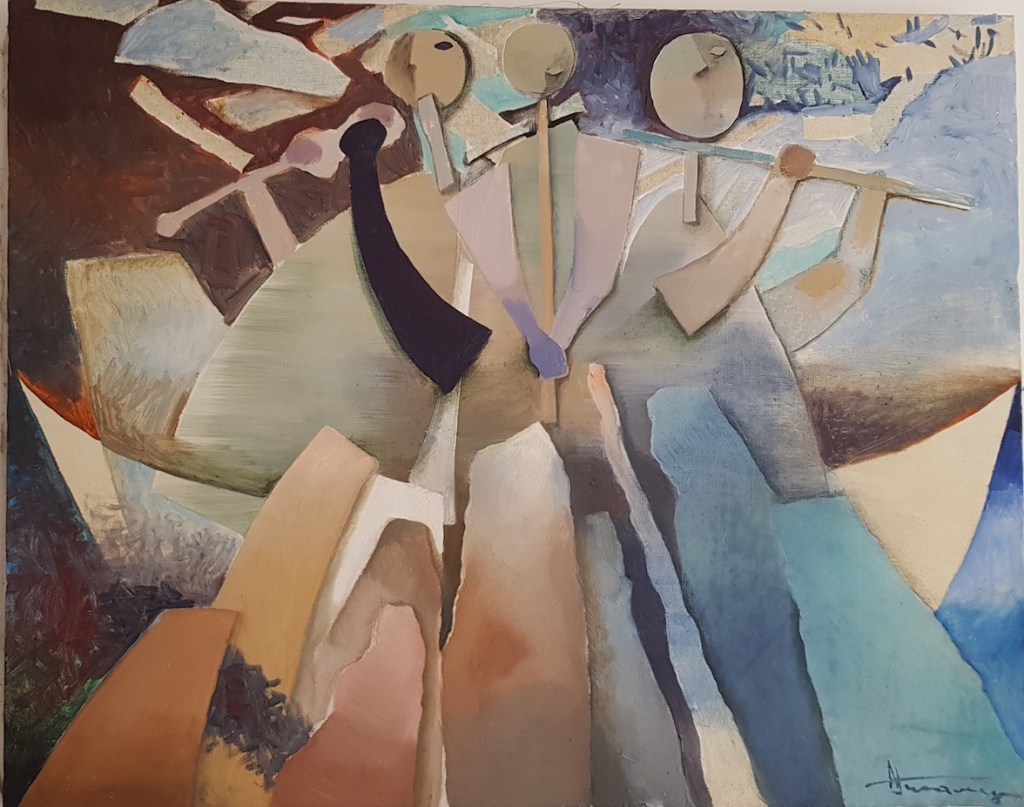
Here I turn to potential investors or art lovers. I sponsored an artist from Kazakhstan for many years in the 1990s. His name was Manas Kisamedinov. He became a close friend. Unfortunately he passed away at the pinnacle of his career from a drug overdose, dying far too early, as did his late a father, the famous graphic artist Makum Kisamedinov. In return I would receive works of art that have been displayed in my home for the past couple of decades. I show here and in the next article paintings that appeared in previous blog entries. More paintings and graphic works will appear in later entries. As time passes, I am now ready to pass them on for the right price naturally.
Painting by Kazakh artist Manas Kisamedinov, 1992.
 Autobiographical
Leave a comment