In the late 1930s, tensions had been growing internationally. After Adolf Hitler was appointed Chancellor of the German Reich (otherwise known as Nazi Germany) in 1933 and assumed definitive control domestically, he turned his gaze further afield. The annexation of Austria in the Anschluss of 1938 and Sudetland in Czechoslovakia was followed shortly afterwards by the signing of the infamous non-aggression pact with the Soviet Union. All this time the British government led by Prime Minister Neville Chamberlain had adhered to a policy of appeasement in an apparent belief that this would bring lasting peace in Europe, a move which backfired spectacularly when Hitler invaded Poland in 1939 on 1 September 1939.
This heralded the start of World War II. A believer in Europe, my dad volunteered, lying about his age in a bid to enlist. He was only seventeen. Fortunately, however, he was turned down when documentation proved that he was under age.
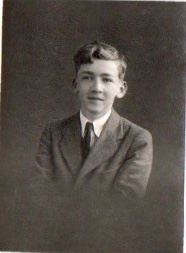
So my father returned to his original goal and took instead the entrance exams to go to Cambridge (Peterhouse, Cambridge). He did so well that he was granted a scholarship and admitted on 19 December 1940 . He was the first person in the family to go to university. In January 1941 he started a degree in history, known in those days as the historical tripos, split into part one (two years) and part two (one year), achieving a 1st in Classical History in both parts (the second part after the end of World War II).
On completion of part one, my dad applied to the RAF, as he had always dreamed of being a pilot. However, this is when he had his second stroke of good fortune. It transpired that his eyesight was too bad. Given the number of brave airmen who made the ultimate sacrifice flying for Britain, this might well have been a blessing in disguise. My dad was no doubt lucky (his future kids definitely were!), although he probably didn’t feel that way at the time, and even less so during a couple of other moments in the war.
He was admitted to the RAF in 1942. Initially he was deployed as a radar specialist. However, my dad had studied the classics and some Russian at school, as well as French and German. Such a background may well have prompted the British authorities to send him on an intense interpreting course in Japanese and then dispatch him to India in 1943 or 1944. I don’t have access to the exact details or dates. Owing to the Official Secrets Act, my father hardly ever talked about the war, although he did open up to me in his 60s when his health was still good. My sister Helen and I assume that he might have interrogated Japanese prisoners-of-war while in India.
However, he did recount one incident on a number of occasions that was to give him a number of sleepless nights, especially in the 1940s. In those days, outhouses were common in India. My dad was doing his business when a snake slithered onto his foot and stopped there for a while, presumably lost in contemplation and methodically considering its next victim. I don’t know how he did it, but my father managed to stay completely still until the serpent slid on, no doubt to cause further mischief.
Another event in the war might also have proved terminal. I would like to add the caveat that the evidence here is not proven. I have yet to receive a response to a request posted months ago to the UK authorities for clarification on my father’s wartime service. The subsequent text is based on what I was told by my mother after my dad had passed away. In her words my dad had stood up for another soldier who had been accused of a crime where the evidence was minimal, to say the least. I will provide here only his first name Norman. In response to his integrity, my dad, who was to end the war as a a flight lieutenant, was allegedly court-martialled by a kangaroo court of the British army elite and sentenced to be shot.
Such actions would be indicative of the strict command system in the army and British society in general – all the more so in countries which were at the time still British colonies – run by the upper class and any other individuals who had fortuitous connections. The army in India was definitely not organised on a merit-based system. Such inequality is still discernible today internationally in business and politics, and most explicitly in film, TV and journalism, as nepotism has flourished.
If this did happen, I cannot imagine his state of mind and emotional distress, as he contemplated the sacrifice of an easy and calm life studying at Cambridge on a scholarship for the sake of his country and Europe.
And then a miracle happened – the end of the war was announced at the start of September 1945. So it would appear, if the story is true, that the trumped-up charges against both men were dropped. They were lucky. Unfortunately, many other brave soldiers were not.
Notwithstanding the horrors that he had witnessed, my dad never wavered in his belief in the UK and the European dream. Overjoyed when we finally joined the EU, he was thankfully no longer around when the snake charmers Farage and Johnson employed various deceits to trigger our country’s exit.
Although it goes without saying that I wish my parents had lived far longer. At least they found each other, for which I am eternally grateful! I will return to their story in the next instalment.
 Autobiographical
Leave a comment